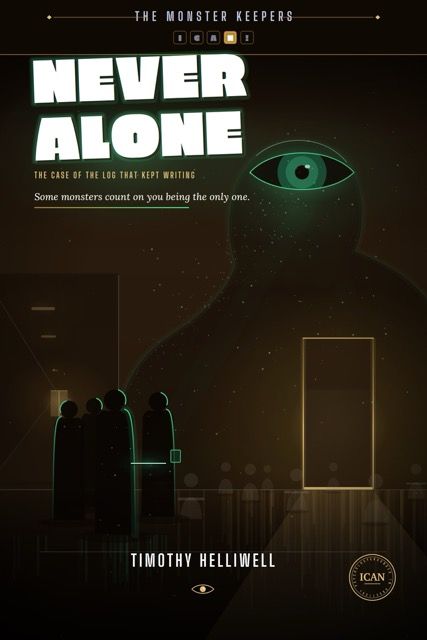
Some monsters count on you being the only one.
Never Alone
The Case of the Log That Kept Writing
Book Four of The Monster Keepers. The story starts at ten past eight in the morning, in a dark entrance hall, with four people standing over a book that none of them owns.
a novel by Timothy Helliwell
Grounded in ICAN Practical Psychology, created by Prof. CK Wong, JP.
The log that kept writing
08:10 · nobody owns this book · four of us
08:12 · two people, or it didn’t happen ·
Nobody in the crew wrote the second line.
Nothing writes in a book at night. That part is invented, and the book says so on its own page. What isn’t invented is set out on four plain pages inside it — one before the story starts, one in the middle of it, one after it ends, and the last page of all.
It plays fair. You can be ahead of them.
Never Alone is a detective story and is meant to be read as one. It plays fair: every clue the children use is on the page before they use it, and a reader who is paying attention can be ahead of them.
A girl in this book is missing for most of it. That part is invented. Out here, when somebody is missing it is a job for grown-ups and for the police, it starts straight away, and it is never a job for their friends.
The grown-ups in this book are real-sized on purpose. They turn up, they believe the children, they do the correct thing — and it is still not enough on its own, because there is one of them and a great many corridors.
A word that everybody says about you is not a fact about you. Whatever is going round, it is a thing people are saying. It is not a finding, and it is not you.
And nobody in this book gets through it on their own. From the book’s own real-life page
A record, not a verdict
Three columns, and no fourth
The front page of the crew’s file has three columns — the time, the words, and who was standing there — and no column for what anybody is like.
What an adult can act on
Ms. Okonkwo, the school librarian, reads a report standing up outside her office: give me a time and give me the words. Before she does anything else with it, she speaks to the person it happened to first, so that he does not find out about it sideways.
Somebody has to hold the other end
Early in the book Sam says that a thing is not true because somebody saw it — it is true when a second person can hold the other end of it.
Four pages step out of the story
One before it starts, one inside it, one after it ends, and the last page of all. They are set apart in the type, they are plain, and they are meant to be read as themselves.
Stand them in order and the spines spell it
I See YouBook 1
Out now. Book One of five, and the letter I.
Claim Your NameBook 2
Out now. Book Two, and the letter C.
Act NormalBook 3
Out now. Book Three, and the letter A.
Never AloneBook 4 · the one you are looking at
Book Four, and the letter N.
I Can!Book 5
Coming soon. Book Five, and the letter !.
Twelve chapters and four plain pages
Chapters
A detective story that plays fair. Every clue the children use is on the page before they use it.
Pages that step out
One before the story starts, one inside it, one after it ends, and the last page of all. Set apart in the type, and plain.
Columns in the file
The time, the words, and who was standing there. There is no column for what anybody is like, and that is the point of it.
Questions at the back
For teachers and book groups, with no right answers. A group that ends up disagreeing has done the work.
Three fears, braided together
Our own research with young readers found the same three fears braided together, again and again.
“If I tell, I’m a snitch — and it will only get worse.”
“No one will believe me, and even if they do, nothing will happen.”
“Maybe it’s me. Maybe there’s something wrong with me.”
From A Note from Prof. CK Wong, JP, printed in full at the back of this book.
“A child in that bind is not being difficult or secretive. They have done the arithmetic and concluded that silence is the safest option available to them.”
“So if you are the parent who found out late, or the teacher who sensed something and did not see it happen — please put down the guilt. You were not failing to notice. You were on the wrong side of a wall the child built for reasons that made sense to them.”
“Which is why this is not a parenting manual, and never pretends to be. It is a story — an adventure, told from a child’s point of view, that never lectures.”
“Read it with your child if they will let you; both the reading and the letting are victories.”
Prof. CK Wong, JP is a Specialist in Psychiatry, Honorary Clinical Professor and former Chairman of the Department of Psychiatry at the Faculty of Medicine, The Chinese University of Hong Kong, and a Fellow of the Royal College of Psychiatrists. He created ICAN Practical Psychology, which this series is grounded in. The author, Timothy Helliwell, writes the story; the psychology under it is Prof. Wong’s.
Knowing when to reach for help is itself one of the strongest moves there is.
Ask, and then wait
The front page of the crew’s file has three columns — the time, the words, and who was standing there — and no column for what anybody is like. Why do you think it is built that way?
The questions grown-ups actually ask
Do we have to have read the first three?
No. Never Alone stands on its own, and Sam will bring you up to speed early — mostly by getting something slightly wrong first and being corrected in capitals by Theo. If you would rather start at the beginning, Book 1 is I See You, and there is a link below.
Is it frightening?
It is a detective story with a monster in it, so it is tense the way a detective story is tense. It is not gory. The strange things the building does are strange rather than gruesome — and the book stops, on its own plain pages, to say out loud which parts are invented. Nothing writes in a book at night.
What are the four plain pages?
One before the story starts, one in the middle of it, one after it ends, and the last page of all. They are set apart in the type. The one inside the story sits between Chapter Six and Chapter Seven, at the hardest practical point in the book. The last page of all is the Help Page, and it lists real services, in a lot of countries.
What age is it for?
Ages 10 and up, twelve chapters. It is written to be read alone, aloud, or over a shoulder. Read it with your child if they will let you.
Does it teach, or does it just tell a story?
It tells a story. The method underneath it arrives sideways — from watching characters try things and get them wrong — and never from a box announcing what the lesson is. There is a separate section at the back, written for grown-ups, if you want the thinking set out plainly.
What if my child recognises too much of it?
Some children will recognise more of this book than they let on. Nothing in the questions at the back asks anybody to talk about their own experience in front of a group, and it is worth saying so out loud before you begin. If something real does surface, it belongs in a quiet conversation afterwards — and the last page of the book is where to go next.
Nobody in this book is taken out of existence, and nobody can be. Every register in that building still has her name on it, and she is herself the whole way through. However loud a thing about you gets, it does not delete you. It cannot. There is no such thing. There is always another one.
Start with the free sample. Ten past eight in the morning, a dark entrance hall, and four people standing over a book that none of them owns.
Grounded in ICAN Practical Psychology, created by Prof. CK Wong, JP. If somebody is hurting your body, threatening you, taking your things, or making you frightened to walk down a corridor, that is not yours to sort out on your own — tell a trusted adult today. The Help Page at the back of this book lists real services, in a lot of countries, whose whole job is this. If you are in danger right now, call your local emergency number. ISBN 978-988-8171-67-5 · micancapital.com · © 2026 MICAN CAPITAL LIMITED
ICAN實踐心理學模式
黃教授及他的團隊,根據ICAN模式研發了完整和有效強化成年人及中、小、幼學生精神健康的課程,這些課程已經在香港、澳門和國內培訓了四十多萬的成年人和學生。
黃重光教授太平紳士
精神科醫學權威
Prof. CK WONG, JP
MB
BS MD FRCPsych FHKCPsych FHKAM (Psychiatry)
香港大學內外全科醫學士
香港中文大學醫學博士
英國皇家精神科醫學院榮授院士
香港精神科醫學院院士
香港醫學專科學院院士
前香港中文大學精神科學系教授兼系主任
現任香港中文大學精神科學系榮譽臨床教授
全人資本有限公司主席
黃重光精神教育學院有限公司主席
全人發展中心榮譽顧問團主席
全人教育基金主席
澳門全人教育促進會監事長
黃教授創立了科學為本、價值為基礎的ICAN實踐心理學模式,並在香港、澳門及國內積極推動提升成年人和兒童心理素質的培訓工作,為建構和諧社會作出努力。中國國際權威專家協會更將其ICAN實踐心理學模式定為「中國醫學研究領域定點研究示範單位」,而ICAN實踐心理學模式也獲得由國家知識產權局主辦的中國國際專利與名牌博覽會頒發「金獎」榮譽。
英國皇家精神科醫學院(Royal College of Psychiatrists)因黃教授致力以他創立的ICAN模式推行強化整體人口精神心理健康的工作,於2013年提名他為「英國皇家精神科醫學院2013年度教育家」(RCPsych Public Educator of the Year),為首位榮獲提名該獎項的華人精神科醫生。
在講學和訓練方面,黃教授在過往的四十多年,積極訓練醫科學生和精神科專科醫生,他並為專業和非專業人士主講超過四千多個講座及研討會。他經常應政府部門及工商業機構邀請,主講有關提升精神心理健康、壓力和危機處理,領袖和團隊訓練,及有關溝通、輔導、紛爭及磋商技巧的講座和工作坊。此外,黃教授曾參與製作超過六百多個有關兒童、家庭和精神心理健康的電視節目,並曾在香港電台主講「父母之道」專題連播的節目長達十二年。
黃教授曾應邀在一千八百個高等法院的民事和刑事訴訟案件中為精神科專家証人。在著作方面,黃教授在專業醫學雜誌刋登了六十多篇精神科醫學研究報告及專業文章,並撰寫了多個有關提升心理素質、心理健康及父母之道的系列書籍。包括《鑽石人生,「ICAN」長命百歲,真棒!》自我導向學課程、《每個人都可以贏在起跑線Be a Winner》、《「ICAN」從心做起,活出100分人生》、《ICAN》系列、《ICAN全人教育》中學系列、《ICAN全人教育》小學系列、《ICAN全人教育》幼兒系列、《更美好的明天》系列、《成長路》系列、《成功父母自學教材》系列、《ICAN幼兒心理學故事叢書》系列。黃教授更研發了《ICAN網上自學課程》系列,使能進一步大規模強化整體人口的精神心理健康。黃教授的最新著作為《培育子女成長為“人生Billionaire”》系列。
MICAN CAPITAL 全人資本
通過ICAN實踐心理學模式,以高效能、低成本、跨越時空限制的精神教育方法,強化整體人口的精神健康。個人方面,達致身心健康、家庭幸福、工作/事業成功;社會方面,達致職場愉快、企業成功、社會和諧進步。
英國政府科學研究所(U.K. Government Office for Science)在 2008 年提出了把人類的大腦視作「精神資本」(Mental Capital)。
『精神資本』包括人的認知和情感資源。它包括認知能力,即能夠靈活和有效地學習,也包括情感智慧,例如社交能力和面對壓力時的心理堅韌力。
因此『精神資本』是決定一個人能對社會作有效貢獻和決定他本人的人生素質的關鍵因素。就是「精神健康」(Mental health)。
24小時情緒及自殺危機支援熱線
香港撒瑪利亞防止自殺會:2389 2222
生命熱線:2382 0000
危機支援服務
明愛向晴軒:18288
東華三院芷若園熱線: 18281
精神健康熱線
醫院管理局24小時精神科電話諮詢服務:2466 7350
醫院管理局思覺失調熱線:2928 3283
社會福利署: 2343 2255
「ICAN精神教育」
使你和家人活得好!
要活得好,無論從個人、職場、學校、家庭、父母的角度,多數人覺得不容易!「ICAN精神教育」協助大家發揮大腦力量、心理力量、人生力量,使你活得好,活得身心健康,家庭幸福,工作事業成功!
我們把「ICAN精神教育」制作成為視頻課程,廣東話、普通話和英文版本各有600多條視頻。
我們誠意邀請你成為「ICAN特選會員」,請按此註冊。你只要每天用五分鐘時間學習網上「ICAN精神教育」,持之以恆地反思、醒覺、實踐,我有信心你會活得好。假如你也是為人父母,我相信你會影響子女,使他們也活得好。
您正在登入「 ICAN 活得好」(粵語版本)
註冊、登入、訂閱和付款、以及所有ICAN精神教育内容將僅限於粵語版本。
如要訪問其他語言内容,您必須另外註冊「ICAN 活得好」的相關語言版本。
You are about to enter ICAN Live Well (English)
精神健康80天尋寶之旅
「精神健康80天尋寶之旅」由五段路程、共80步組成。我建議你平均每天行一步,只要你運用「反思、醒覺、實踐」三個步驟去學習,當你完成整個旅程時,我有信心你會強化了自己的到精神健康,並得到身心健康、家庭幸福、工作/事業成功三個人生無價寶。
你也會得到「ICAN精神教育」第一階段和第二階段完成證書。
以下是80日旅程的簡介:
第一段路程:
第1步:登記為ICAN 特選會員
第2步:了解自己的精神健康狀態
走完第2步,你到達了第一站,你會了解自己的精神健康狀態。無論狀態是怎樣,只要你繼續80日的旅程,我有信心你的精神健康會由不好變好、好變更好!
第二段路程:
第3至12步:認識精神健康和了解「ICAN 精神教育」
(每步約需10 分鐘)
走完第12步,你到達了第二站,你已經深刻體會精神健康的重要,及了解「ICAN精神教育」怎樣強化你的精神健康和使你得到人生三個無價寶。
第三段路程:
第13 至24步:激發精神力量
(每步約需5分鐘)
走完第24步,你到達了第三站,只要你實在地運用了「反思、醒覺、實踐」學習,你會激發了自己的精神力量,而且見到自己有進步。
你並會得到「ICAN
精神教育」第一階段完成證書。
第四段路程:
第25 — 48步:持續發揮精神力量 — 掌握大腦力量、心理力量、人生力量的方法
(每步約需5分鐘)
走完第48步,你到達了第四站,通過繼續運用「反思、醒覺、實踐」,你掌握了持續發揮大腦力量、心理力量和人生力量的方法,及見到自己不斷繼續進步。
第五段路程:
第49 —80步:持續發揮精神力量 — 得到身心健康、家庭幸福、工作/事業成功三個人生無價寶(每步約需5分鐘)
走完第80步,你到達了第五站,也即是完成了「精神健康80天尋寶之旅」。
你強化了自己的精神健康,並得到身心健康、家庭幸福、工作事業成功三個人生無價寶,及有能力影響家人、朋友、同事,使他們也活得好。
你並會獲頒發「ICAN精神教育」證書,這兩張證書反映你重視精神健康,及掌握了「ICAN精神教育」的方法。
現在我邀請你踏上「精神健康80天尋寶之旅」!
黃重光教授,JP